
Insurance Balances vs Patient Balances: Why They Need Different Follow-Up

Insurance and patient balances work best when each one gets its own stack and its own follow-up.
Your practice's accounts receivable holds two kinds of money. Insurance balances are what dental plans still owe on claims you've sent. Patient balances are what patients owe for copays, deductibles, and the share their plan didn't cover. They need different follow-up because the person you're asking is different, and so is the next step. Tracking them separately, and posting every EOB as soon as it comes in, keeps both numbers accurate.
Who owes what
An insurance balance starts the day a claim goes out. It stays open until the plan pays, denies, or asks for more information, and until that EOB is entered and posted to the patient's ledger.
A patient balance is the part the patient is responsible for. Some of it is known at checkout, like a copay. Some of it only becomes clear once the EOB comes back and shows what the plan actually paid.
That's the key point: until the EOB is posted, the patient's share is only an estimate.
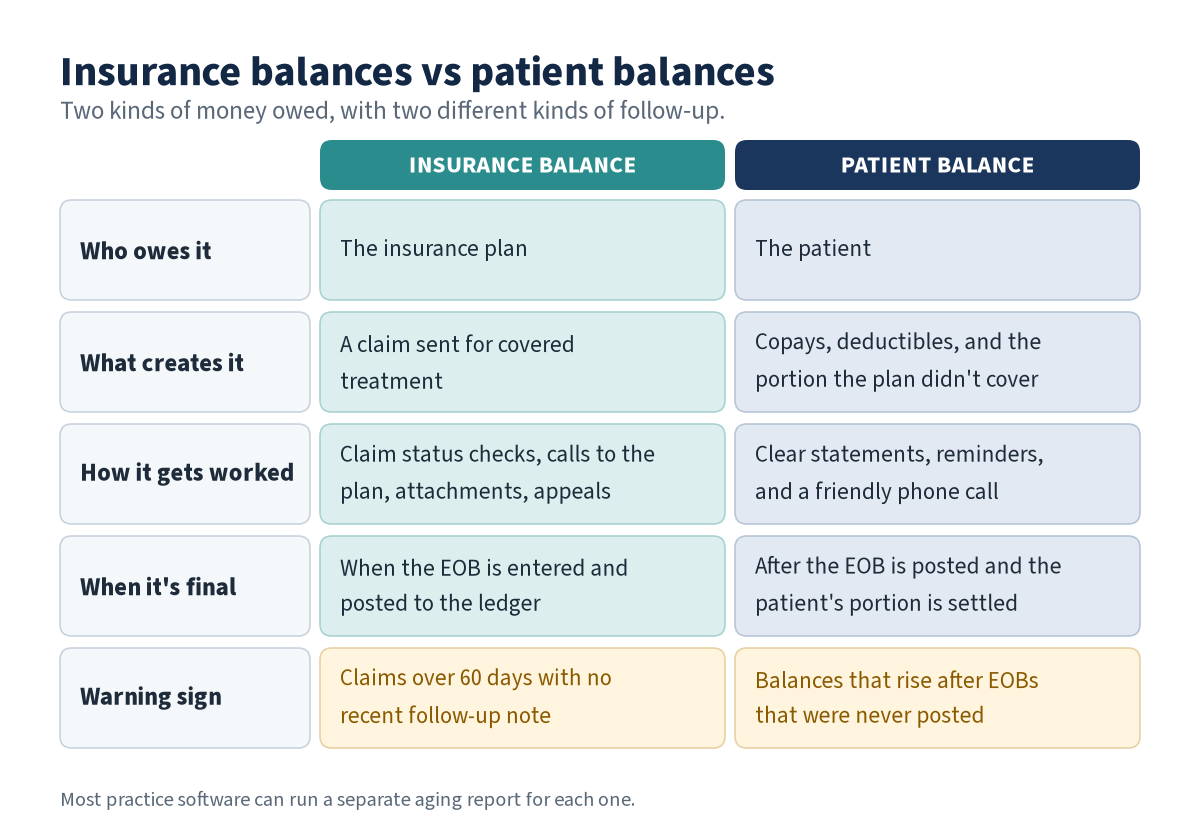
Two kinds of money owed, with two different kinds of follow-up.
Why mixing the two hides problems
When insurance and patient balances sit together in one total, it's hard to see what's really going on. A few common examples:
A paid claim still looks open. If the plan paid but the EOB was never posted, the claim stays on the insurance side and the patient's real balance never shows up.
Patients get billed too early. If a statement goes out before the EOB is posted, the patient may be billed for money the plan is about to pay. That can mean confused phone calls and refunds later.
Patients get billed too late. If the plan paid less than the estimate, the patient owes more. Until the EOB is posted, nobody knows to send that bill.
Old insurance claims hide in a healthy-looking total. One strong month of patient payments can cover up a growing pile of insurance claims over 90 days.
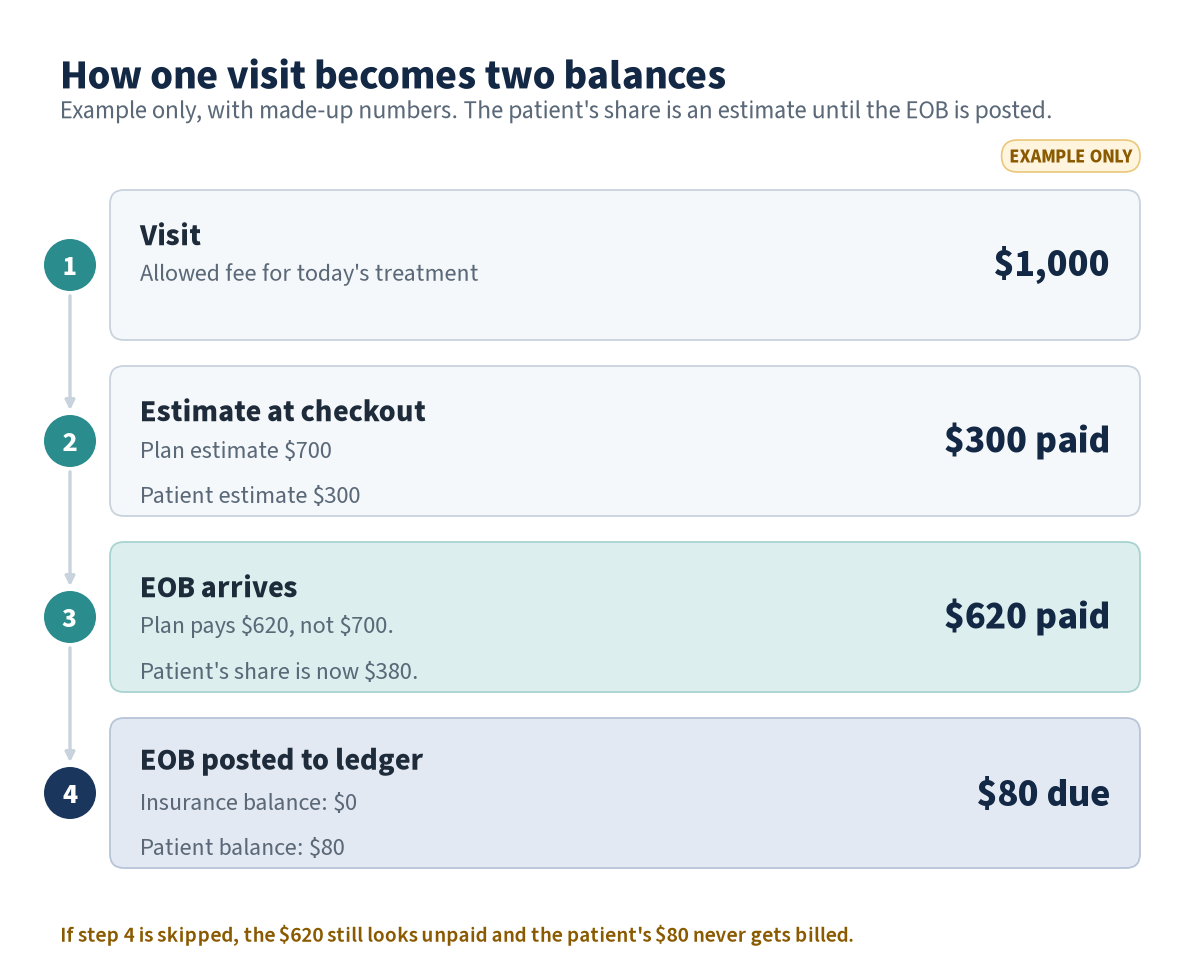
Example only, with made-up numbers. The patient’s share is an estimate until the EOB is posted to the ledger.
How to work insurance balances
Insurance follow-up is about the claim itself. For each open claim:
Check the status on the plan's portal or by phone.
Find out what's holding it. It could be a missing x-ray or narrative, an eligibility question, or a coding issue.
Fix and send. Send the attachment, a corrected claim, or an appeal if it was denied.
Note the next step and a date so no claim sits without someone working it.
Enter and post the EOB as soon as it arrives, including short-paid and underpaid claims, so the patient's share is right.
Run the insurance aging report every week and start with the oldest and largest claims. Our post on how to read a dental aging report walks through what to check first.
How to work patient balances
Patient follow-up is about clear communication. It works best when:
The EOB is posted first, so the amount on the statement is the real amount.
Statements are simple and show the visit date, what the plan paid, and what's left.
Reminders go out on a steady schedule, with a friendly phone call for balances that sit too long.
Estimates are explained at checkout, so patients know their share may change once the plan pays.
Run the patient aging report on its own schedule, often monthly, right after statements go out.
A simple routine for your office
Every week: review the insurance aging report, follow up on claims over 30 days with no recent note, and post every EOB that came in.
Every month: run the patient aging report after EOBs are posted, send statements, and call on older patient balances.
Every month, side by side: compare the 61–90 and 90+ columns on both reports. If either keeps growing, that's where to focus.
When it's time to get help
If EOBs are piling up, patient balances keep changing after statements go out, or nobody has time to call the plans, it may be time to get some help. Our team at SoRa handles dental insurance billing, with a dedicated biller for your office. We enter and post EOBs into your patient ledgers, follow up on unpaid claims, and work denials, short-paid and underpaid claims, so the patient balances in your ledger match what each plan actually paid. It's one flat monthly fee, never a percentage of your collections. To see what's included and how switching works, read what an outsourced dental billing service includes.
FAQ
What's the difference between an insurance balance and a patient balance? An insurance balance is what a dental plan still owes on a claim. A patient balance is what the patient owes, such as copays, deductibles, and anything the plan didn't cover.
Why does a patient's balance change after their visit? At checkout, the patient's share is an estimate. Once the plan's EOB comes back and is posted, the real amount shows up. If the plan paid less than expected, the patient's share goes up. If it paid more, it goes down.
Should we send patient statements before insurance pays? It's usually best to wait until the EOB is entered and posted. That way the statement shows the right amount, and patients get fewer surprise bills and fewer refunds.
Why is our insurance A/R high when patients are paying on time? Strong patient payments can hide insurance claims that are getting old. Run the insurance aging report on its own and look at the 61–90 and 90+ columns for claims with no recent follow-up.
What does SoRa's Free Aging Check look at? It's a free first look at your unpaid, pending insurance claims, so you can see what's stuck and what's worth working first.
Not sure what's sitting on the insurance side?
Start with a Free Aging Check, a free first look at your unpaid, pending claims, so you can see what's stuck and what's worth working first. You can also call us at 201-564-0439 or book a time to talk.