
Most dental billing companies charge in one of two ways: a flat monthly fee, or a percentage of what they collect. With a flat fee, you pay the same amount every month, so the cost is easy to plan. With a percentage, the fee moves up and down with your collections. Neither one tells you everything, so look at the fee, what work it covers, and who will be working your claims.

A flat monthly fee gives your office one billing number to plan around.
How percentage billing works
With percentage billing, the company keeps a share of the money it collects for your office. The rate and what it applies to are set in the contract. Some companies figure the rate on insurance payments only. Others count patient payments too.
The appeal is easy to see. The fee is tied to collections, so in a slow month you pay less. Some offices like that the billing company earns more when more money comes in.
The tradeoff is that your cost rises as your practice grows. Add a hygiene day, bring on an associate, or have a strong month, and the fee goes up with it, even if the billing work stayed about the same. It can also be harder to budget, because the exact fee is only known once the month is over.
How flat fee billing works
With a flat fee, you pay one set amount each month for the billing work in your agreement. The fee is usually based on things like your claim volume and how many providers you have, and it stays the same whether you collect a little more or a little less that month.
The biggest plus is predictability. Your office manager can put one number in the budget and plan around it. When collections grow, the billing cost stays where it is, so more of that growth stays with the practice.
The thing to check with any flat fee is the scope. Ask exactly what work the monthly fee covers, so you can compare offers fairly.
Example numbers: what each model can cost
To show the math, here are example numbers. Say one company charges a flat $1,500 a month and another charges 6% of collections. At $20,000 collected in a month, the percentage fee is $1,200. At $35,000, it's $2,100. At $50,000, it's $3,000. The flat fee is $1,500 each time.
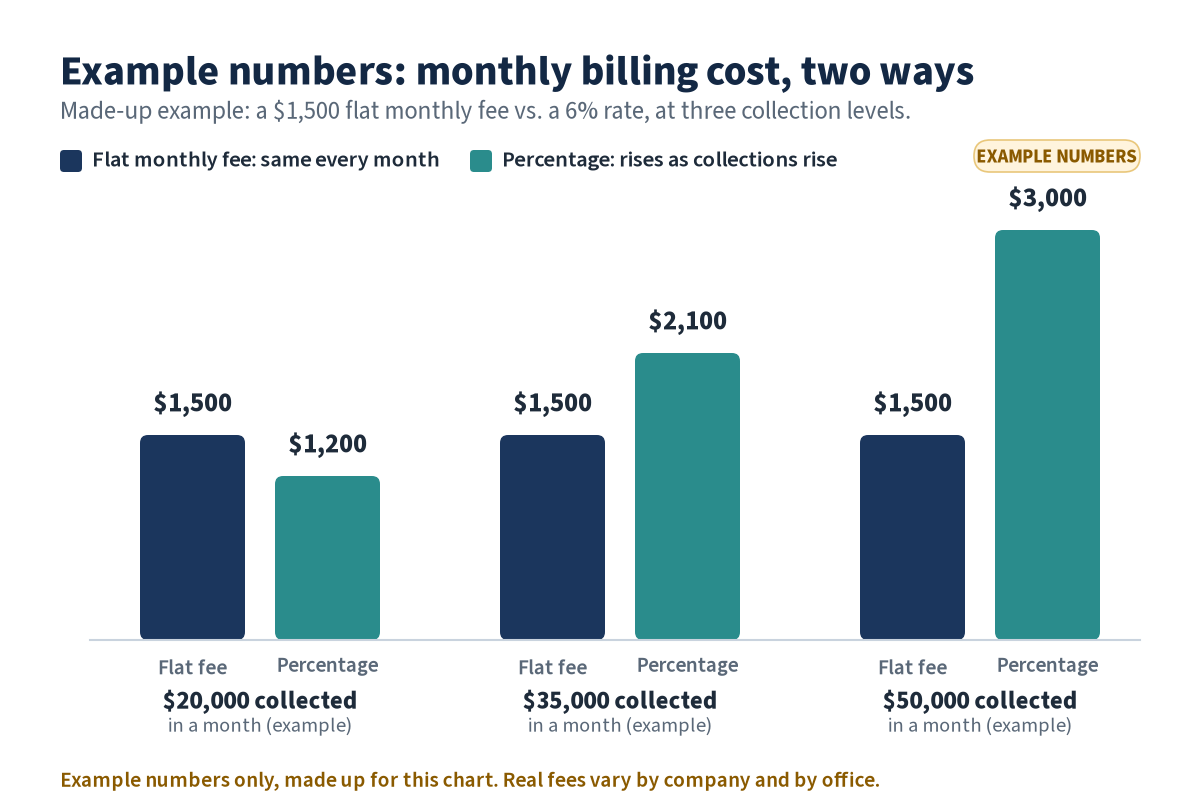
Example numbers only. A percentage fee follows your collections, and a flat fee stays the same.
These are example numbers to show the math. Real fees vary by company and by office. The point is the pattern: a percentage fee follows your collections, and a flat fee stays put.
What to compare besides the price
Price matters, but the work behind it matters just as much. A low fee with slow follow-up can leave money sitting in your aging report. When you compare billing companies, look at:
What's covered. Claim submission, EOB entry and posting, denials, short-paid and underpaid claims, and follow-up on open claims.
Who does the work. A dedicated biller who knows your office, your plans, and your providers, or a shared queue.
How you'll see progress. Ask how they report on open claims and your aging report. If you need a refresher, our guide on how to read a dental aging report walks through the buckets.
How they handle problem claims. Ask how they work denials and old claims. Our posts on what to do after a dental claim denial and old dental claims over 90 days show what good follow-up looks like.
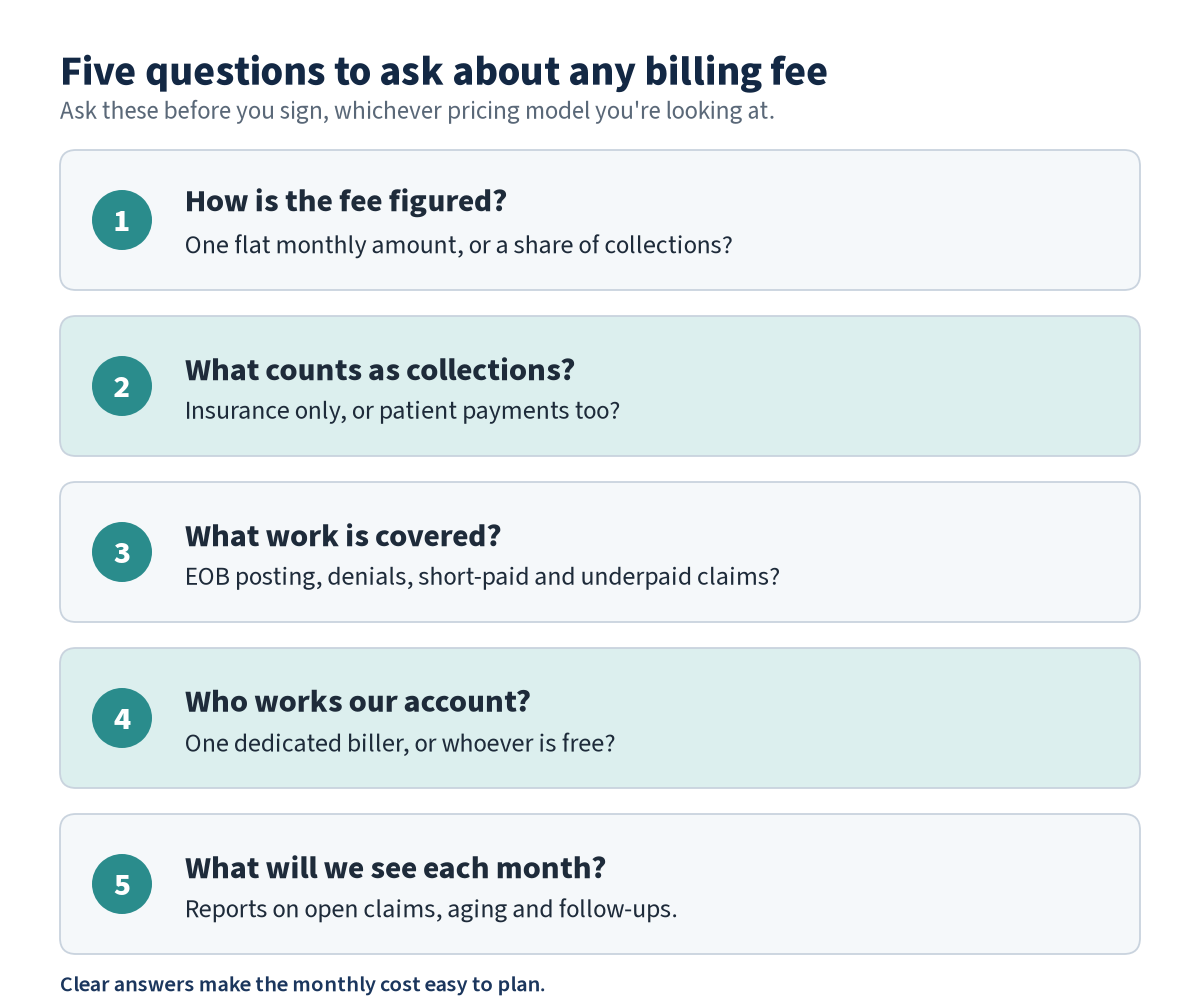
Five questions that make any billing quote easier to compare.
How SoRa charges
At SoRa, we charge one flat monthly fee, never a percentage of collections. When your collections grow, our fee stays the same.
Each office gets a dedicated biller. Our team posts your EOBs to your patient ledgers, so your insurance and patient balances stay accurate. We work denied, short-paid and underpaid claims, and we follow up with the plans on your open claims. We work only with dental offices, so dental billing is all we do. For a full look at the day-to-day work, see what an outsourced dental billing service includes.
If you'd like a number for your office, call us. Tell us about your office, and we'll quote you one flat monthly fee, never a percentage of collections.
FAQ
Is a flat fee or a percentage better for a dental office? It depends on your office, but some owners prefer a flat fee because it's easy to budget and stays the same as collections grow. A percentage can cost less in a slow month and more in a busy one. Compare the fee along with the work it covers.
What percentage do dental billing companies usually charge? Rates vary by company, by office size, and by what counts as collections. Ask each company for its rate in writing, what it applies to, and what work it covers.
Will our billing cost go up if our collections go up? With percentage billing, yes, the fee rises with collections. With a flat monthly fee, the cost stays the same when collections rise. At SoRa, it's one flat monthly fee, never a percentage of collections.
What should a monthly billing fee cover? Look for claim submission, EOB entry and posting, follow-up on open claims, and work on denied, short-paid and underpaid claims. Also ask who will work your account day to day. At SoRa, each office gets a dedicated biller.
How do we find out what SoRa would cost for our office? Call us at 201-564-0439 or book a time to talk. Tell us about your office, and we'll quote you one flat monthly fee, never a percentage of collections. You can also start with a Free Aging Check, a free first look at your unpaid, pending claims, so you can see what's stuck and what's worth working first.
Want a clear monthly number for your billing?
Call us at 201-564-0439 or book a time to talk, and we'll walk you through our flat monthly fee for your office. You can also start with a Free Aging Check, a free first look at your unpaid, pending claims, so you can see what's stuck and what's worth working first.